How On-Device AI is Changing Privacy in Smartphones
1/11/20267 min read
Introduction to On-Device AI and Privacy
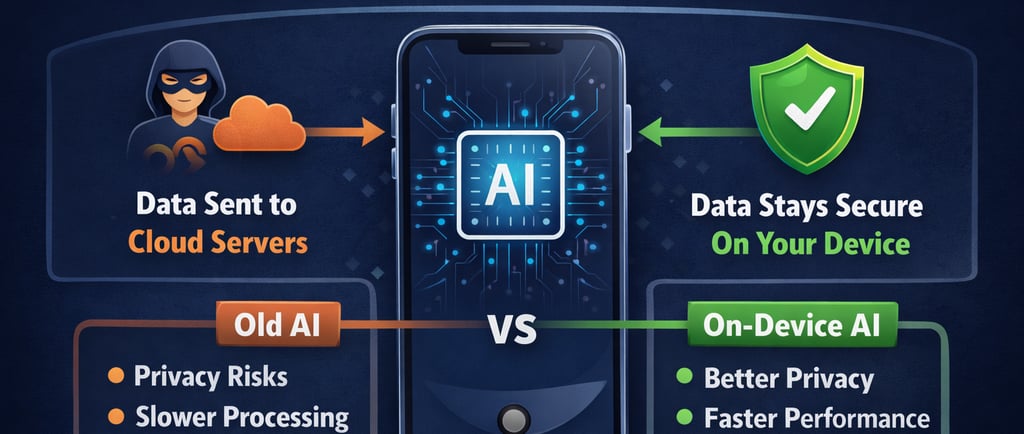
On-device artificial intelligence (AI) refers to the implementation of AI algorithms and processing directly on user devices, such as smartphones or tablets, rather than relying on cloud-based solutions. This paradigm shift is largely made possible by the continuous enhancement of smartphone hardware, including more powerful processors, advanced neural processing units (NPUs), and efficient battery management. Consequently, on-device AI facilitates real-time data processing, enhancing the user experience without requiring the upload of sensitive information to remote servers.
The growing prevalence of AI technologies in mobile devices raises significant privacy concerns. Data breaches and misuse of personal information have sparked a worldwide conversation about the importance of safeguarding privacy in the digital age. Users increasingly demand greater control over their data, leading to a skepticism towards cloud-based solutions, where data is often stored and processed outside the user's immediate control. This shift in perception highlights the need for technologies that prioritize user privacy while still delivering the benefits of AI.
On-device AI addresses these privacy concerns by processing data locally. For instance, AI applications such as voice assistants, image processing tools, and personalized recommendations can function effectively without transmitting potentially sensitive data to external servers. Thus, user information remains secure on the device, minimizing the risk of data exposure. As AI technology evolves, the advancements in smartphone hardware enable more sophisticated applications to run efficiently on-device, further reinforcing the notion that data privacy can be preserved without compromising functionality.
Ultimately, as consumers become more aware of the importance of privacy, the demand for on-device AI solutions is likely to grow, allowing users to harness the power of AI while maintaining control over their personal data.
The Evolution of Privacy Concerns in Smartphones
Privacy issues concerning smartphones have evolved significantly since their inception. Initially, mobile devices served primarily as communication tools, with limited personal data being stored or shared. However, as smartphones became more advanced, featuring extensive functionality through apps and connectivity, the landscape of privacy concerns transformed dramatically. With this technological advancement, the potential for data breaches and misuse of personal information has become a major concern for users.
Several high-profile incidents have heightened awareness regarding smartphone privacy. For instance, the data breach affecting millions of users' information in 2013 brought to light the vulnerability of data within commonly used applications. Similarly, revelations about unauthorized data collection practices have caused distrust among consumers, compelling them to scrutinize how their data is being utilized. Such events have highlighted the precarious balance between the convenience offered by smartphones and the personal information that users inadvertently expose.
The role of application permissions has also played a critical part in the evolution of privacy concerns. As users have become more aware of which permissions are necessary for app functionality, many have begun to adopt a more cautious approach to installing applications. This shift is evidenced by the increasing demand for transparency in data practices, pushing app developers and companies to prioritize user consent and data protection measures to maintain trust.
As user awareness has evolved from indifference to vigilance, concerns regarding smartphone privacy have escalated into a paramount issue. Users now actively seek control over their data, influencing the development of privacy-first practices by smartphone manufacturers and app developers. This change emphasizes the necessity for robust privacy measures, which is essential in an era dominated by mobile devices.
How On-Device AI Enhances Privacy
In the modern digital landscape, the significance of privacy has escalated, particularly for smartphone users. Implementing on-device AI technology represents a transformative approach to managing personal data without compromising security. By processing data locally, rather than relying on cloud-based solutions, devices equipped with on-device AI enhance user privacy significantly.
One of the primary benefits of on-device AI lies in its ability to analyze and process data directly on the user's smartphone. This localized processing allows for real-time insights and decision-making, eliminating the need to transmit sensitive user data to external servers. Consequently, individuals can use their devices with a heightened sense of security, knowing that their information is not being shared over potentially vulnerable networks.
Moreover, intelligent assistants powered by on-device AI can deliver tailored experiences while respecting user confidentiality. For instance, these applications can learn from user behavior, preferences, and habits to provide personalized recommendations without compromising privacy. By retaining this information solely on the device, they ensure that users are not inadvertently exposing their data to third-party entities.
Several popular smartphone brands have already integrated on-device AI capabilities. For example, Apple's Siri and Google Assistant utilize advanced algorithms that process voice commands locally, reducing the need to send voice recordings back to the cloud for analysis. Similarly, features such as Google Photos leverage on-device AI to categorize pictures without compromising the privacy of what users store on their devices.
Ultimately, on-device AI represents a pivotal advancement in privacy protection for smartphone users. By keeping data processing local, this technology fosters a more secure and personalized user experience, thereby alleviating concerns surrounding data transparency and user confidentiality.
Limitations of On-Device AI
On-device AI technology has emerged as a game-changer in enhancing privacy on smartphones; however, it does come with notable limitations that must be acknowledged. One of the primary challenges is the computational power of mobile devices. Compared to cloud-based solutions that utilize expansive computing resources for data processing, on-device AI is often constrained by the hardware capabilities of smartphones. This limitation can hinder the complexity of algorithms that can run on the device, impacting the performance and speed of AI applications.
In addition to computational constraints, the amount of data that can be processed on a smartphone is significantly less than what can be handled in the cloud. While on-device AI allows for data to be processed locally, thus minimizing data exposure to external servers, it also means that the AI is often working with a limited dataset. This can lead to decreased accuracy and effectiveness of AI predictions and functionalities. The learning algorithms may struggle to identify nuanced patterns or trends, reducing their overall utility in comparison to their cloud counterparts that have access to vast pools of data.
Moreover, user misconceptions about the level of privacy provided by on-device AI can lead to overconfidence in security measures. Many users may assume that because data is processed locally, it is completely safe. However, vulnerabilities still exist, including potential exploitation of device security or inadequate management of AI behavior by users. It is crucial for users to have a realistic understanding of on-device AI’s capabilities and limitations, as this balance will help in leveraging its privacy benefits effectively while acknowledging its shortcomings.
Case Studies of On-Device AI in Action
As smartphone technology advances, manufacturers are increasingly harnessing the capabilities of on-device AI to enhance user privacy. Notable examples include Apple, Google, and Samsung, each implementing distinct technologies that highlight the transformative potential of this approach.
Apple has turned to on-device AI for its facial recognition system, Face ID, which utilizes machine learning algorithms to identify users securely. By processing facial data directly on the device, Apple reduces reliance on remote servers, thereby enhancing data security. Users benefit from improved authentication without compromising their privacy. However, some critics have raised concerns over the potential for bias in facial recognition technology, prompting Apple to continually refine its algorithms based on user feedback.
Google, on the other hand, has developed a feature called Live Caption, which employs on-device AI to transcribe audio in real-time. This function operates directly on the smartphone, ensuring that sensitive audio content is not sent to external servers for processing. This approach not only secures user privacy but also enhances accessibility for hearing-impaired individuals. Despite the overall positive reception, users have voiced concerns regarding accuracy, particularly in noisy environments, which Google continues to address through updates to its machine learning models.
Samsung's implementation of on-device AI can be observed in its Bixby virtual assistant, which processes user commands locally for quicker responses. This strategy reduces data transmission, bolstering privacy as sensitive queries remain on the device. However, some users have expressed skepticism about Bixby’s ability to understand complex commands, highlighting a gap in functionality that Samsung aims to bridge through ongoing improvements.
These case studies demonstrate how leading smartphone manufacturers are innovating with on-device AI to provide users with enhanced privacy and security features. The balance between technological advancement and user privacy remains a focal point, with enhancements continually informed by user experiences and feedback.
User Perception and Adoption of On-Device AI
The growing prevalence of on-device artificial intelligence (AI) in smartphones has sparked significant interest among users regarding its implications for privacy. Recent surveys illustrate that a considerable number of smartphone users are becoming increasingly aware of how on-device AI integrates into their daily lives, enabling personalized experiences while raising concerns about data security. According to a report by XYZ Research, approximately 70% of respondents expressed a favorable view of on-device AI features, perceiving them as beneficial for enhancing smartphone functionality and user experience.
However, user trust remains a significant hurdle that on-device AI must overcome. While many users appreciate the convenience offered by AI-powered applications, concerns over privacy continue to dominate discussions. Data shows that around 60% of respondents are apprehensive about how their personal data is utilized by these devices. Expert opinions highlight that the level of transparency provided by manufacturers can significantly influence user adoption. A clear understanding of how data is processed locally versus in the cloud can alleviate many fears associated with privacy risks.
Moreover, willingness to adopt smartphones integrating on-device AI functionalities varies among demographics. Younger generations, specifically millennials and Gen Z, show a higher inclination towards embracing such technologies, driven by a desire for efficiency and enhanced features in their devices. Conversely, older demographics are more cautious, prioritizing privacy protection above the advantages of improved user experiences. As awareness of on-device AI continues to grow, it is evident that manufacturers need to prioritize privacy assurances and foster user education around security measures to build trust and encourage broader adoption of these transformative technologies.
The Future of On-Device AI and Privacy in Smartphones
The landscape of smartphone technology is evolving rapidly, driven by advancements in on-device AI. This innovation is not merely a trend; it represents a significant shift towards enhancing user privacy. As manufacturers increasingly integrate AI capabilities directly into devices, the future appears promising for stronger data security measures. On-device AI reduces dependency on cloud processing, enabling devices to analyze user data locally without requiring it to be uploaded to servers, thereby minimizing exposure to potential data breaches.
Moreover, regulatory frameworks surrounding data privacy are continually evolving. Governments worldwide are implementing stricter regulations to safeguard user information. These regulatory changes compel manufacturers to innovate and prioritize user privacy in their product offerings. Consequently, compliance with these regulations not only builds consumer trust but also fosters a competitive edge in the smartphone market. As dynamic as this landscape is, the implications are profound; consumers can expect to see features that allow for enhanced control over their data, including more transparent consent mechanisms and user-friendly privacy settings.
The collaboration between developers and manufacturers is paramount for further advancing on-device AI capabilities. By fostering open communication and sharing best practices, stakeholders can work together to develop applications that prioritize user privacy while delivering value. This collaborative spirit may lead to innovative solutions such as advanced predictive text, personalized content, and context-aware applications without sacrificing security. Ultimately, users will benefit from a more intuitive experience, while developers can create more robust applications.
In conclusion, the future of on-device AI in smartphones holds significant promise for the protection of user privacy. With advances in technology, evolving regulatory frameworks, and collaborative efforts between developers and manufacturers, it is poised to reshape how personal data is managed and secured. Users can look forward to more control over their information and enhanced privacy protections that will likely redefine the smartphone industry.